


Not all car insurance is created equal. The right cover depends on the vehicle, the budget, and how much financial risk the driver or owner is comfortable carrying. Third party insurance is considered a basic form of cover, while comprehensive insurance covers a much wider range of scenarios. Understanding the difference makes it easier to choose wisely.
What comprehensive car insurance actually covers
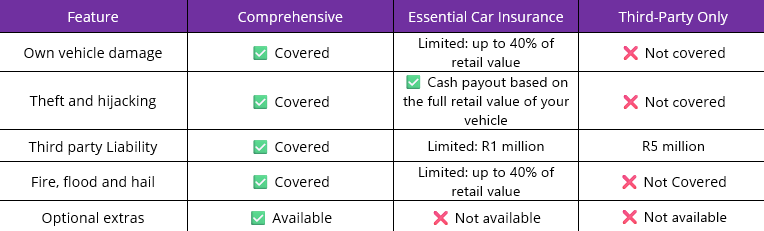
Comprehensive car insurance is the most complete form of protection available. A standard policy typically includes:
- Damage to the insured vehicle from accidents, theft, hijacking, , fire, or an act of nature (e.g. hail storm)
- Total loss settlement where the vehicle is written off, stolen, or hijacked and not recovered
- Windscreen repair or replacement for chips and cracks
- Damage to someone else's vehicle: up to R5 million or more, depending on the insurer
- Roadside assistance as standard, with optional extras such as car hire available at an additional premium.
Drivers who rely on their vehicles every day and want to avoid large unexpected expenses will find comprehensive cover the more practical long-term choice.
The real cost of third party only insurance
Third party insurance covers damage caused to someone else's vehicle or building, nothing more. Any damage to the insured person's own car comes entirely out of pocket. Premiums are lower, which can make it an appealing option, but a single accident, theft, or hijacking can quickly cost far more than the savings accumulated on a cheaper monthly premium. It is worth doing the sums before assuming less cover means better value.
OUTsurance Essential: smarter cover for older vehicles
Drivers with cars older than five years, unfinanced, and valued under R130,000 have a third option worth considering. OUTsurance Essential sits between basic third party and full comprehensive cover, offering meaningful protection at a more accessible price point. It includes:
- Third party liability: up to R1 million
- Theft and hijack cover: a cash payout at the full retail value of the vehicle
- Accidental damage: covers damages up to 40% of the item’s retail value, paid out in cash.
It is a straightforward, no-frills policy that offers more protection than third party alone, without the premium that comes with a fully comprehensive plan.
How the three options compare
How to choose the right cover
- Start with the vehicle. Its age, value, and whether it is financed will narrow down the options quickly.
- Be honest about financial risk. Consider what an unplanned repair or replacement would mean for monthly finances.
- Match the policy to the car. Essential works well for older, lower-value vehicles. Claims are also paid out in cash which means that you can select a panel beater of your choice. Comprehensive makes more sense for newer or financed cars.
- Compare the full picture. Premiums matter, but so do included benefits, client service, cashback rewards (check out the cash OUTbonus), and the insurer's claims reputation.
Comprehensive insurance costs more, but it also offers the most protection. For most drivers, that trade-off makes sense, particularly when weighed against the potential cost of a major accident or theft. Third party cover has its place, but it leaves significant financial gaps. OUTsurance Essential fills some of those gaps for qualifying vehicles at a competitive price.
The smartest insurance decision is one that balances cost with real protection as opposed to looking at price only.
Get an OUTsurance car insurance quote to find cover that fits your vehicle, your lifestyle, and your budget.
Frequently Asked Questions
Is comprehensive car insurance worth your while?
Yes. OUTsurance comprehensive car insurance provides you with all-round protection in case of accidental damage, an act of nature (e.g. hail storm), intentional damage, liability cover, theft, hijacking, and fire.
What is the difference between comprehensive and third party insurance?
Third party insurance is a basic form of car insurance that covers you for damage you caused to someone else’s property whereas comprehensive car insurance covers your own vehicle as well as the damage you caused to someone else’s vehicle.
What is the difference between third party insurance, third party cover, liability insurance and liability cover?
There is no difference. These are all commonly used terms to refer to cover where you cause to someone else’s property and for which you can be held legally liable.
Give me a real-case scenario of third party cover vs. comprehensive cover.
Alex drives a car valued at around R220,000. One day, Alex causes an accident that damages another vehicle and leaves their own car beyond repair. If Alex only has third party cover, the other driver’s accident damage will be covered — but not the damage to Alex’s vehicle. That means repairing it or replacing it comes straight out of Alex’s pocket.
With comprehensive cover, the situation looks very different. The other driver’s car is covered, and so is Alex’s. The insurer pays out the value of the car, less an excess, making it far easier for Alex to get back on the road.
That’s the key difference. Third party cover may be cheaper month to month, but comprehensive cover protects your car (and your finances) in the event of an accident.